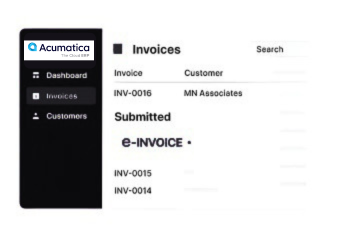
Compliance Capabilities Designed for Acumatica
How Acumatica Data Flows Through Advintek
- Identify Financial Sources: Relevant Acumatica financial records are selected according to applicable invoice, transaction, and GDT requirements.
- Capture Customer Context: Customer accounts and billing references are collected to establish complete commercial transaction relationships.
- Review Sales Details: Sales orders, shipments, and billing information are evaluated before invoice records are assembled.
- Validate Purchase Information: Purchasing records are checked alongside supplier details to support accurate transaction relationships.
- Structure Invoice Data: Validated ERP information is organized into structured records for electronic invoice processing.
- Route Processed Records: Prepared invoice information proceeds through connected finance environments for GDT-compliant downstream processing.
What Advintek Connects Across Acumatica
Acumatica contains interconnected financial and operational information across accounting, sales, purchasing, distribution, and customer processes. Advintek can coordinate selected ERP records so invoice preparation reflects the original transaction context instead of treating each electronic invoice as an isolated financial document.
- Connect receivables with customer accounts
- Associate shipments with sales transactions
- Relate purchase receipts with suppliers
- Link projects with financial records
The Practical Impact Across Acumatica
- Receivable Transaction Context: Customer receivable information remains associated with originating transactions, supporting clearer invoice preparation and financial review.
- Shipment Fulfillment Relationships: Shipment references can provide fulfillment context for invoices generated from Acumatica sales and distribution activities.
- Project-Based Billing: Project-related financial information can support invoice preparation where billing originates from project accounting operations.
- Branch Organizational Coordination: Branch and organizational information can help identify the appropriate business context behind ERP transactions.
- Cash Application Context: Relevant payment application references can provide additional financial context around customer invoice relationships.
- Account Financial Classification: Acumatica account structures can help preserve financial classification when invoice information enters downstream processing.
Core Vietnam E-Invoicing Tools
Invoice Data Validation
Acumatica invoice information undergoes structured validation before entering connected Vietnam e-invoicing workflows.
Document Lifecycle Control
Acumatica invoice records can follow organized processing stages while retaining relevant ERP transaction references.
Financial Record Preservation
Acumatica accounting references remain associated with invoice information to support organized financial record management.
Acumatica Support Across Vietnam
Advintek connects Acumatica business records with Vietnam e-invoicing workflows, organizing branch, project, shipment, and financial dimension information for structured invoice preparation and downstream processing.
- Manage branch-specific invoicing workflows
- Align project billing information
- Associate shipment data with invoice records
- Incorporate financial dimensions into compliance workflows
Simplify Your Electronic Invoice Process
Acumatica ERP supports Vietnam e-invoicing through coordinated validation workflows.
Integrated with Acumatica ERP. Processed through Advintek.
Ready e-Invoice System
Frequently Asked Questions Acumatica e-Invoicing in Vietnam
What Acumatica data can be used when preparing Vietnam e-Invoices?
Acumatica can supply customer, sales, billing, tax, inventory, payment, and financial information required for invoice preparation. Depending on the transaction, project, order, shipment, or branch details may also provide useful supporting context. Advintek organizes relevant ERP data into structured invoice workflows, allowing businesses to retain connections between source transactions and the resulting electronic invoice records.
Can Acumatica support invoice processing for multiple branches?
Yes. Acumatica branch and organizational structures can help identify which business unit, location, or entity generated a transaction. This information can remain associated with invoice data as it moves through the processing workflow. Advintek can use applicable Acumatica references to organize invoices according to their originating business context, supporting clearer financial review across multiple operating units.
How are customer orders handled during Acumatica e-Invoicing?
Customer orders can provide the commercial foundation for invoices generated through Acumatica. Order numbers, customer details, products, quantities, prices, and related transaction information can be carried into invoice preparation where applicable. Advintek structures these records for electronic invoice processing while preserving the relationship between the original sales activity and the corresponding invoice information.
Does Acumatica inventory information affect electronic invoices?
Inventory records can contribute product, quantity, item, warehouse, and transaction details when goods are included in customer billing. These records may originate from sales orders, shipments, or other Acumatica processes. Advintek can organize relevant inventory information with invoice data, helping maintain traceability between item-level activity, commercial transactions, and structured electronic invoice documents.
How does Acumatica handle tax information for Vietnam invoices?
Tax information maintained within Acumatica can form part of the data reviewed before an electronic invoice is prepared. Applicable rates, amounts, customer details, and transaction values can be associated with the originating financial records. Advintek helps structure this information for Vietnam invoice workflows, supporting validation and processing against applicable General Department of Taxation(GDT) requirements.